
Standards Compliance
Standards
IEC 60601-1; 2005/AMD1:2012 |
Medical electrical equipment - Part 1: General requirements for basic safety and essential performance |
IEC 60601-1-2; 2014/AMD1:2020 |
Medical electrical equipment - Part 1-2: General requirements for basic safety and essential performance - Collateral Standard: Electromagnetic disturbances - Requirements and tests |
IEC 62304; 2006/AMD1:2015 |
Medical device software - Software life cycle processes |
IEC 62366-1:2015 |
Medical devices - Part1: Application of usability engineering to medical devices |
ISO 14971:2019 |
Medical devices - Application of risk management to medical devices |
Electromagnetic Comparability (EMC)
IEC 60601-1-2: 2014 |
Medical electrical equipment - Part 1-2: General requirements for basic safety and essential performance - Collateral Standard: Electromagnetic disturbances |
Electromagnetic Comparability Declaration
Medical equipment needs special precautions regarding electromagnetic compatibility (EMC), and
needs to be installed, and put into service according to the EMC information provided in this document.
|
Inspector may cause radio interference or may disrupt the operation of nearby equipment. It may be necessary to take mitigation measures, such as re-orienting or relocating the device or shielding the location. |

- Electromagnetic Emissions
Guidance and manufacturer's declaration - Electromagnetic Emissions |
||
Inspector is intended for use in the electromagnetic environment specified below. The user of Inspector should assure that it is used in such an environment. |
||
Emissions Test |
Compliance |
Electromagnetic Enforcement - Guidance |
RF Emissions CISPR 11 |
Group 1 |
Inspector uses RF energy only for its internal function. Therefore, its RF emissions are very low and are not likely to cause interference in nearby electronic equipment. |
RF Emissions CISPR 11 |
Class A |
Inspector is suitable for use in all establishments other than domestic, and may be used in domestic establishments and those directly connected to the public low voltage power supply network that supplies buildings used for domestic purposes. |
Harmonic Emissions IEC 61000-3-2 |
Class A |
|
Voltage fluctuations/flicker emissions IEC 61000-3-3 |
Complies |
|
- Electromagnetic Immunity
Guidance and manufacturer's declaration - Electromagnetic Immunity |
|||
Inspector is intended for use in the electromagnetic environment specified below. The user of Inspector should assure that it is used in such an environment. |
|||
Immunity Test |
IEC 60601-1-2 Test Level |
Compliance Level |
Electromagnetic Environment Guidance |
Electrostatic discharge (ESD) IEC 61000-4-2 |
±8 kV contact ±15 kV air |
±8 kV contact ±15 kV air |
Floors should be wood, concrete or ceramic tile. If floors are covered with synthetic material, the relative humidity should be at least 30%. |
Electrical fast transient/burst IEC 61000-4-4 |
±2 kV for power supply lines. ±1 kV for input / output lines |
±2 kV for power supply lines. ±1 kV for input / output lines |
Mains power quality should be that of a typical hospital environment. |
Surge IEC 61000-4-5 |
±1 kV differential mode ±2 kV common mode |
±1 kV differential mode ±2 kV common mode |
Mains power quality should be that of a typical hospital environment. |
Voltage dips, short interruptions and voltage variations on power supply input lines IEC 61000-4-11 |
0% UT for 0.5 cycles* 0% UT for 1.0 cycle* 70% UT for 25 cycles (50 Hz)/ 30 cycles (60 Hz) 0% UT for 250 cycles (50 Hz)/ 300 cycles (60 Hz) |
0% UT for 0.5 cycles 0% UT for 1.0 cycle 70% UT for 25 cycles (50 Hz)/ 30 cycles (60 Hz) 0% UT for 250 cycles (50 Hz)/ 300 cycles (60 Hz) |
Mains power quality should be that of a typical hospital environment. If the user of Inspector requires continued operation during power mains interruptions, it is recommended that Inspector be powered from an uninterruptible power supply or a battery. |
Power frequency (50/60 Hz) magnetic field IEC 61000-4-8 |
30 A/m |
30 A/m |
Power frequency magnetic fields should be at levels characteristic of a typical location in a typical hospital environment. |
Note: UT is the AC mains voltage prior to application of the test level. |
|||
* According to IEC 60601-1-2: 2014
Guidance and manufacturer's declaration - Electromagnetic Immunity |
|||
Inspector is intended for use in the electromagnetic environment specified below. The user of Inspector should assure that it is used in such an environment. |
|||
Immunity Test |
IEC 60601-1-2 Test Level |
Compliance Level |
Electromagnetic Environment Guidance |
Conducted RF IEC 61000-4-6 Radiated RF IEC 61000-4-3 |
3 Vrms 150 kHz to 80 MHz outside ISM bands 6 Vrms 150 kHz to 80 MHz in ISM bands 3 V/me 80 MHz to 2.7 GHz |
3 VRMS 6 VRMS 3 V/m |
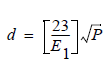
Portable and mobile RF communications equipment should be used no closer to any part of Inspector, including cables, than the recommended separation distance calculated from the equation applicable to the frequency of the transmitter. Recommended separation distance:
where P is the maximum output power rating of the transmitter in watts (W) according to the transmitter manufacturer and d is the recommended separation distance in meters (m). Field strengths from fixed RF transmitters, as determined by an electromagnetic site survey, c should be less than the compliance level in each frequency range. Interference may occur in the vicinity of equipment marked with the following symbol:
|
Note 1: At 80 MHz and 800 MHz, the higher frequency range applies. Note 2: These guidelines may not apply in all situations. Electromagnetic propagation is affected by absorption and reflection from structures, objects and people. |
|||
|
|||
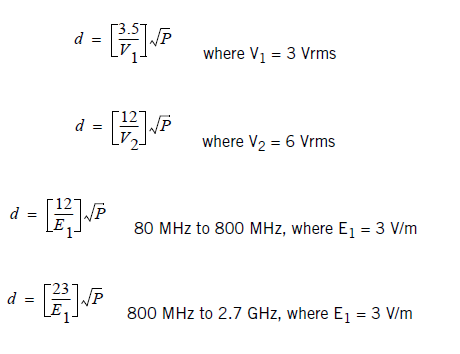

Recommended separation distances between portable and mobile RF communications equipment and Inspector |
||||
Rated maximum output power of transmitter (W) |
Separation distance according to frequency of transmitter (m) |
|||
150 kHz to 80 MHz outside ISM bands
|
150 kHz to 80 MHz in ISM bands
|
80 MHz to 800 MHz
|
800 MHz to 2.5 GHz
|
|
0.01 |
0.12 |
0.12 |
0.12 |
0.23 |
0.1 |
0.37 |
0.38 |
0.38 |
0.73 |
1 |
1.17 |
1.20 |
1.20 |
2.30 |
10 |
3.96 |
3.79 |
3.79 |
7.27 |
100 |
11.67 |
12.00 |
12.00 |
23.00 |
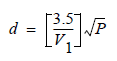
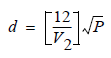
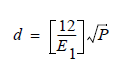
For transmitters rated at a maximum output power not listed above, the recommended separation distance d in meters (m) can be determined using the equation applicable to the frequency of the transmitter, where P is the maximum output power rating of the transmitter in watts (W) according to the transmitter manufacturer. |
||||
Note 1: At 80 MHz and 800 MHz, the separation distance for the higher frequency range applies. Note 2: The ISM (industrial, scientific and medical) bands between 150 kHz and 80 MHz are 6.765 MHz to 6.795 MHz;13.553 MHz to 13.567 MHz; 26.957 MHz to 27.283 MHz; and 40.66 MHz to 40.70 MHz. Note 3: An additional factor of 10/3 has been incorporated into the formulae used in calculating the recommended separation distance for transmitters in the ISM frequency bands between 150 kHz and 80 MHz and in the frequency range 80 MHz to 2.7 GHz to decrease the likelihood that mobile/portable communications equipment could cause interference if it is inadvertently brought into patient areas. Note 4: These guidelines may not apply in all situations. Electromagnetic propagation is affected by absorption and reflection from structures, objects and people. Note 5: The minimum separation distance for RF communication equipment operating within the following frequency bands is 0.3 m: • 380 –390 MHz (TETRA 400) • 430 – 470 MHz (GMRS 460, FRS 460) • 704 – 787 MHz (LTE Band 13, 17) • 800 – 960 MHz (GSM 800/900, TETRA 800, iDEN 820, CDMA 850, LTE Band 5) • 1 700 –1 990 MHz (GSM 1800; CDMA 1900; GSM 1900; DECT; LTE Band 1, 3, 4, 25; UMTS) • 2 400 – 2 570 MHz (Bluetooth, WLAN, 802.11 b/g/n, RFID 2450, LTE Band 7) • 5 100 – 5 800 MHz (WLAN 802.11 a/n) |
||||
Safety
Protection Against Electric Shock |
Class 1 |
Degree of Protection Against Electric Shock |
Type B |