
Introduction
Inspector™ is a unique customizable & scalable system for real time monitoring based on cloud computing technology. It is designed to work as an advanced tool for data logging in any industrial environmental and medical applications. Inspector™ monitors environmental conditions, electrical parameters and any critical parameters needed by customers, suitable for any sophisticated systems, modalities, environment or facilities. The cloud-based service of the inspector™ ensures excellent performance, high data security, cost effectiveness and scalability that overcome the traditional servers’ problems.
Highlighted Features:
- Electrical Measurement
Inspector™ monitor single-phase or three-phase voltage up to 1000 VAC, frequency range (40 – 70) Hz. The Inspector™ records current waveforms, RMS amps up to 1000 A, power.
It measures watts, VAR’s, power factor, and other power-related parameters.
- Power Quality Measurement
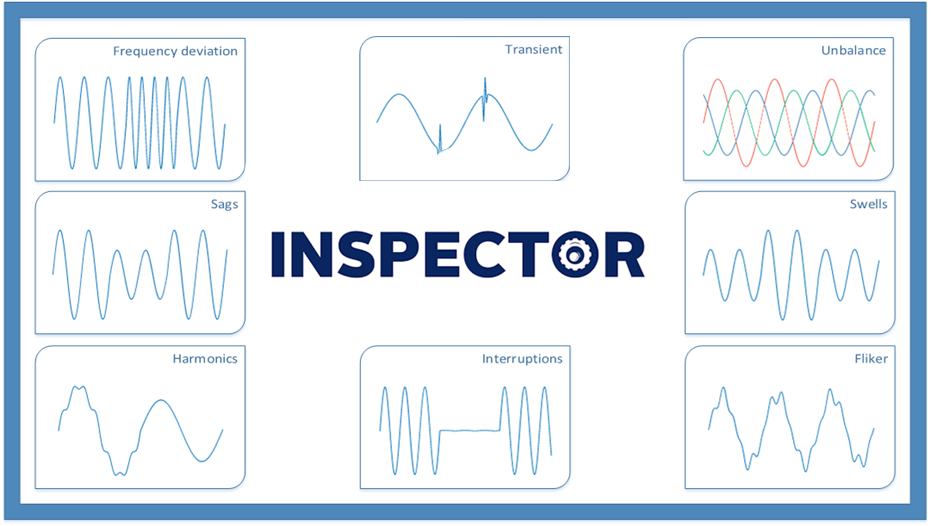
Inspector™ records disturbances on the mains circuit: sags/dips, swells, interruptions, frequency variations and transient. It also records impulses, unbalance, flicker, and THD, and trend data.
- Measurement Parameters
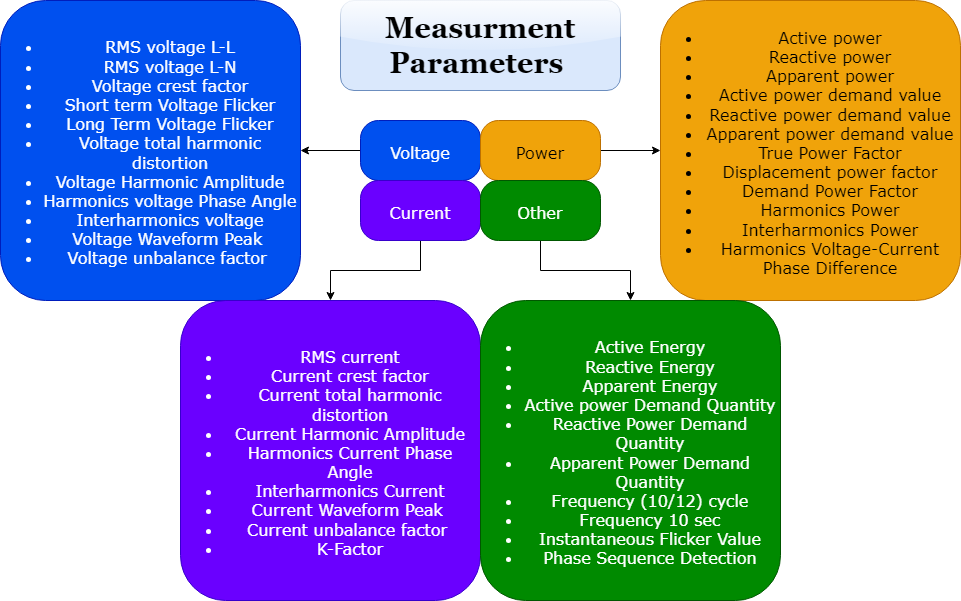
Inspector™ measures, monitors and triggers the difference voltage between neutral and earth, monitor current readings, power demand, frequency and more.
- Earth Current
Inspector™ measures, monitors and triggers the earth current via split core current sensor up to 10 A. - Earth Resistance
Inspector™ measures, monitors and triggers the earth resistance up to 200 Ω. - Environmental Measurement
Inspector™ measures and triggers on temperature at up to three locations for temperature, using ATMP sensor. Also Inspector™ measures and monitor carbon dioxide (CO2), total volatile organic compounds (TVOC), and oxidizing gases such as (NOx or O3), Particulate Matter (PM), Temperature, Relative Humidity, Barometric Pressure and vibration using addressable THPAQ Module up to 128 locations. - Motors Measurements
Inspector™ measures and monitor the consumption current for any type of Motors, non-invasively using addressable MMU module up to 128 motors based on split core current transformer. - Extra Sensor Support
Inspector™ has 2 interfaces(4-20)mA, SIB module which provide 8 interface (4-20) mA to monitor any parameter such as fluid temperature, fluid flow, fluid pressure and PH - High capacity lithium-ion battery
Inspector™ has chargeable lithium battery work for 6 hour. - Direct contact to cloud
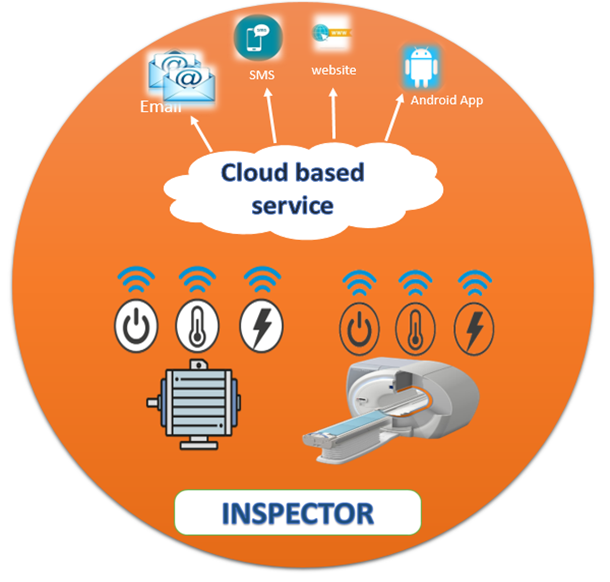
Inspector™ has Cloud-based service Can be accessed through mobile, PC, Laptop. You can monitor parameters, configure Inspector™, or even update its firmware remotely.
- Alert service
Inspector™ has configuration option for alarm thresholds and notification alerts via email, SMS, android app. - USB Interface
Inspector™ has two USB port to connect flash memory for data exportation - SD card Interface
Inspector™ has SD card port to get extra storage. - Multiple Data Format
Export data for multiple formats (PDF, JSON, CSV) - Easy wiring and configure
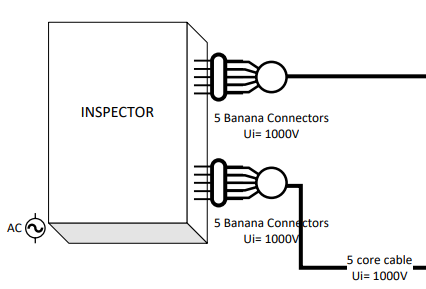
Inspector™ has an easy wiring connection via bananas and LEMOs interfaces.
- Analyze data and create reports
Inspector™ has Friendly user interface, display data with statistical graph.
Applications
Power quality issues are present across the whole electric infrastructure. Having Inspector™ which monitors these PQ issues helps to improve performance, quality of service, and equipment lifetime while reducing economic losses.
Factories
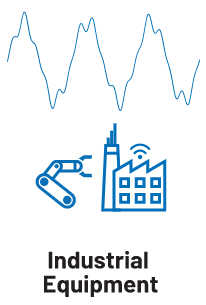
Degradation of power quality is usually caused by intermittent loads and load variations from arc furnaces and industrial motors. Such disturbances give rise to surges, dips, harmonic distortions, interruptions, flicker, and signaling voltages. To detect and record these disturbances inside a factory installation, it is necessary to have power quality monitoring equipment in several points throughout the electric installation or, even better, have it at the load level. With the arrival of new Industry 4.0 technologies, Inspector™ (power quality monitoring) at the load can be addressed by industrial panel meters or submeters to have a comprehensive view of the quality of the power delivered to each load.
EV Chargers
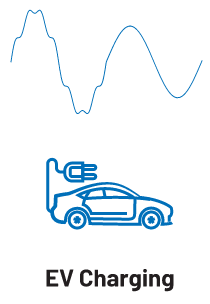 EV chargers can face multiple power quality challenges, both in power sent to and from the grid from a power distribution company perspective, power electronics-based converters used in EV chargers inject harmonics and interharmonics. Chargers with improperly designed power converters can inject direct currents (DC). Additionally, fast EV chargers introduce rapid voltage changes and voltage flicker into the grid. From the EV charger side, faults in transmission or distribution systems lead to voltage dips or interruption of supply voltage to the charger. Reduction of voltage from the EV charger tolerance limits will lead to activation of under voltage protection and disconnection from the grid (which leads to a very bad user experience). Adding Inspector™ (power quality monitoring) on the EV chargers helps manage equipment maintenance, or replacement and improve performance, quality of service.
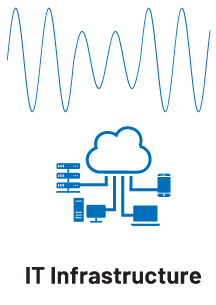 Data Centers/Server Rooms
Presently, most business activities depend on data centers in one way or another to provide email, data storage, cloud services, etc. Data centers demand a high level of clean, reliable, and uninterrupted electricity supply. Inspector™ PQ monitoring excellence helps managers prevent costly outages and helps manage equipment maintenance, or replacement, required due to issues on the power supply units (PSU). The integration of uninterruptable power supply (UPS) systems into rack power distribution units (PDUs) represents another reason to add Inspector™ PQ monitoring to IT racks inside the data center. This integration can provide visibility to power issues at a power socket level.
PV solar systems
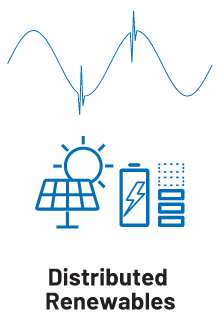 Electricity generation by wind and photovoltaic (PV) solar systems injected into the grid cause several power quality problems as well. On the wind generation side, wind intermittency creates harmonics and short-duration voltage variations.4 The inverters in PV solar systems create noise that can produce voltage transients, distorted harmonics, and radio frequency noise because of the high speed switching commonly used to increase the efficiency of the energy harvested. Adding Inspector™ (power quality monitoring) on the PV systems helps manage equipment maintenance, or replacement and improve performance, quality of service.
Medical Imaging Equipment
 Utility companies serve the hospitals with distribution systems that include generating stations, which are power substations that supply electricity via transmission lines. The voltage supplied via these transmission lines is stepped down to lower levels by substation transformers, which inject certain harmonics or interharmonics to the system. Harmonic currents in distribution systems can cause harmonic distortion, low power factor, and additional losses as well as overheating in the electrical medical equipment, leading to a reduction in the lifetime of equipment and increases in cooling costs. Adding Inspector™ (power quality monitoring) on the medical scanners (MRI, CT, X-Ray) helps manage equipment maintenance, or replacement and improve performance, quality of service.
Created with the Personal Edition of HelpNDoc: Create HTML Help, DOC, PDF and print manuals from 1 single source