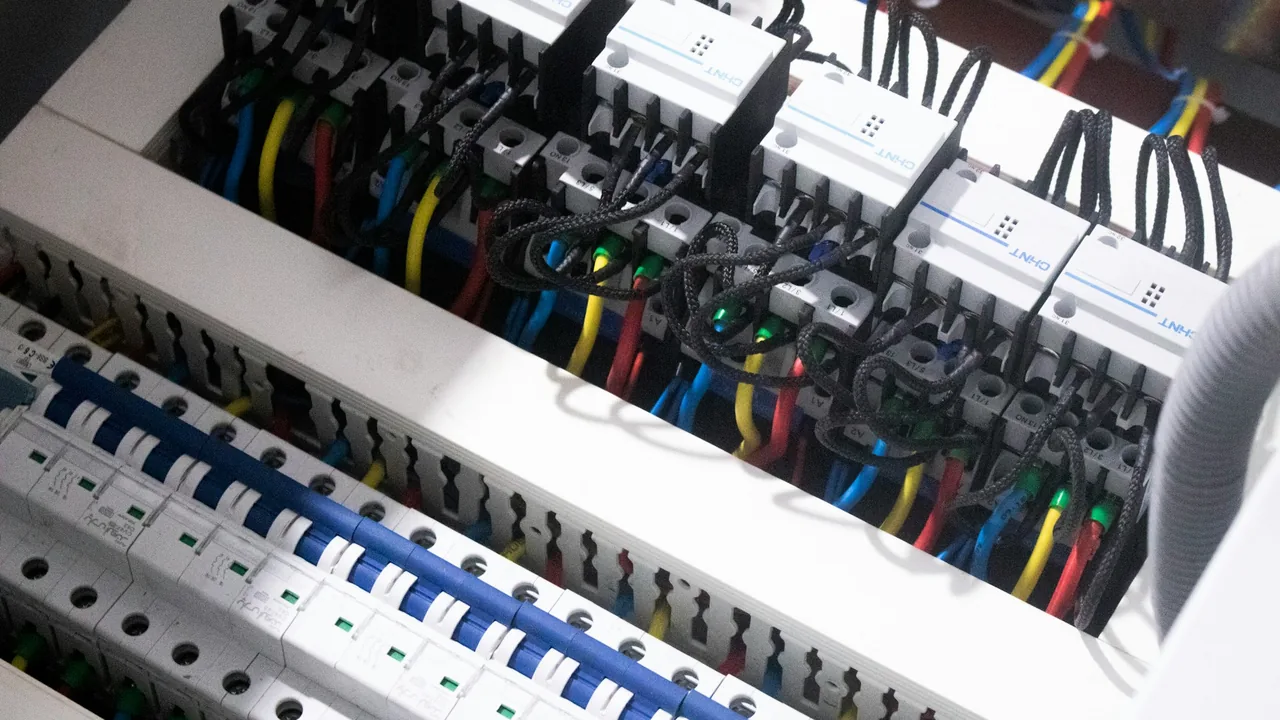
“Predictive maintenance” is sold as a dashboard that tells you, weeks in advance, which motor will fail and when. In practice, the plants that get value from condition monitoring use it for something more modest and more useful: deciding which asset deserves a closer look first, and proving afterwards that the intervention worked.
This guide covers three levels of evidence — basic vibration trends, motor current signature analysis (MCSA) and advanced vibration diagnostics — what each one can and cannot tell you, and how to escalate between them.
The question to answer
Which asset is changing enough to justify a closer look — and what evidence supports that? Notice that the question is about prioritising inspection, not predicting a failure date.
Level 1: basic vibration trends for screening
A site with many similar pumps, fans and motors rarely has enough specialist time to analyse each one. Repeated manual readings, taken at different positions and speeds, produce a spreadsheet in which a change in the machine cannot be told apart from a change in the measurement method.
Make the measurement repeatable first:
- define a fixed location, direction and mounting method for each asset,
- take readings at a comparable operating speed and load,
- record what the transmitter’s output actually represents — overall velocity, acceleration or another processed quantity — and its range and unit,
- flag open-circuit, saturated and missing values, instead of letting a dead sensor read as “low vibration”.
Then use the trend to spot departures from that asset’s own baseline, and from machine-specific limits.
A 4–20 mA vibration transmitter is a scalar, not a waveform. A conventional overall transmitter supplies a processed number. It does not preserve the raw vibration signal needed for an FFT or envelope spectrum. Basic trending is therefore a screening and escalation tool. ISO 20816-3 gives severity guidance for a defined range of industrial machines — it is not a universal bearing-damage classifier.
Inspector accepts 4–20 mA sensors through its sensor interface board (eight inputs per board), and its air-quality module includes a three-axis accelerometer (1–400 Hz) for basic vibration and shock detection. The non-invasive Motor Measure Unit adds three channels of motor current via split-core coils.
Level 2: motor current signature analysis
Some motors are hard to reach — submerged, enclosed or in hazardous areas — and some fleets are simply too large for frequent vibration routes. Motor current signature analysis offers another screening route: it looks for characteristic frequency components in the supply current that can be associated with rotor, bearing, eccentricity or stator conditions.
The catch is that those frequencies depend on the motor’s speed. Get the speed wrong and you look in the wrong place.
Worked example: why slip matters
- A 50 Hz, four-pole induction motor has a synchronous speed of 1,500 rpm.
- Measured running speed is 1,470 rpm, so slip = (1,500 − 1,470) ÷ 1,500 = 0.02.
- The common broken-rotor-bar screening frequencies are f × (1 ± 2s) = 50 × (1 ± 0.04) = 48 Hz and 52 Hz.
- If the speed estimate is off, these locations move. Even a peak in the right place needs corroboration and repeatability before it means anything.
For MCSA to be useful:
- acquire current with sufficient resolution, and record supply frequency, pole count, load and reliable speed or slip,
- build a baseline in comparable operating states,
- keep signal-quality indicators and acquisition settings with every spectrum,
- treat VFD-fed and grid-fed motors as separate cases — they need separately validated analysis assumptions.
When a feature appears, ask whether a speed change, a supply harmonic, process modulation or a measurement artefact explains it before you ask whether the motor is damaged.
Current signatures indicate candidate conditions — not an exact damage location, a severity or a remaining useful life. A negative screen does not guarantee a healthy motor. MCSA on Inspector depends on the released algorithm and configuration; confirm what is enabled for your installation.
Level 3: advanced vibration diagnostics
When an overall trend identifies a change but cannot explain it, the next step is a waveform-capable measurement. Before trusting it, confirm that the full sensor-to-software path preserves a suitable waveform: bandwidth, sampling, anti-aliasing and calibration. Add a verified speed or phase reference when the analysis depends on it. Run-up, coast-down, order, phase and orbit analysis each need their particular sensors and a validated configuration.
Interpret spectra against speed, load and machine construction. A change in overall energy, a rotational component or an impulsive pattern can justify a hypothesis — none is uniquely diagnostic without context. The output should be a short diagnostic statement:
- the leading mechanism,
- the observations that support it,
- the competing explanations,
- the next confirmation step.
Confirm before you replace
Rank persistent anomalies by asset criticality and corroborating evidence. Then confirm the suspected mechanism with an independent method — a vibration route, thermal inspection, an electrical test or a maintenance inspection — before anyone orders a motor. After the work, remeasure at the same location and at a comparable speed and load, and record the physical finding. That record is what makes the next alert more trustworthy.
What to measure to show value
- the share of investigations that produced a confirmed finding,
- the false-alarm burden on the maintenance team,
- the time from a persistent anomaly to a review,
- whether features stay stable after maintenance.
A defensible result is a better maintenance decision and a verified operating change — not a claim of exact remaining life.
Related reading
- VFD trips and motor stress: check the supply first
- Prioritising maintenance across remote sites and fleets
- What a power quality analyzer actually tells you
Too many motors, not enough specialist time?
Tell us what you run and how it is maintained today. An engineer will suggest where screening pays off first. Book a meeting